.webp)
%402x.svg)
Discover our
resources


The activities or sequences of activities proposed here are accessible from the age of 8, but will also work very well—provided the language is adapted—in middle school or even high school, and in any context where a particularly technical explanation of AI is not expected!
Autonomous Robot Race
Duration: 15 minutes to 2 hours
The "Autonomous Robot Race" activity is ideal for all audiences aged 8 and up, allowing them to discover the main principles of AI while having fun. And it allows you to go quite far: understanding training data, AI biases, showing the AI model (artificial neural network).
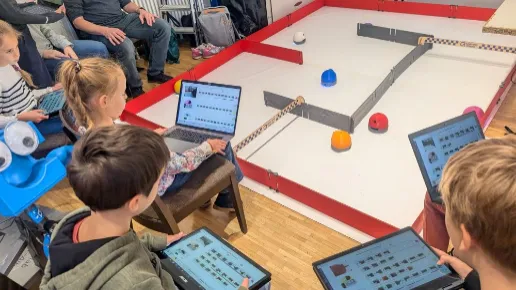
If you want to continue with a similar, fun training exercise, you can choose the Robot Follower activity.
Course: “Four Levels of AI Autonomy”
Duration: 3-4 hours
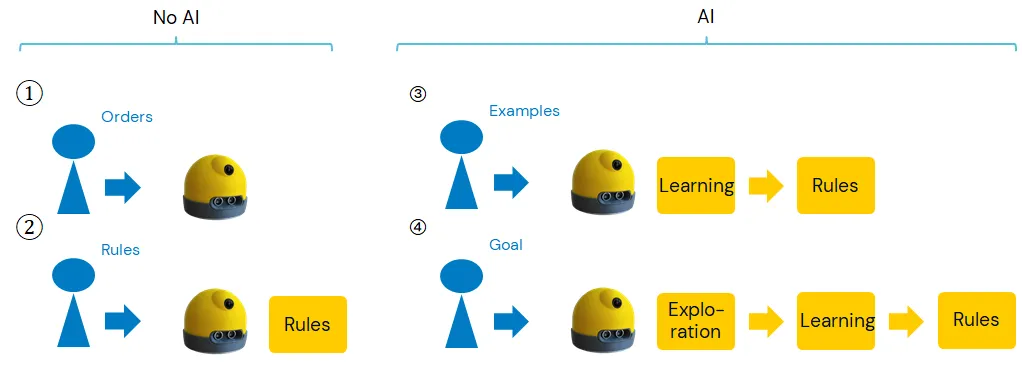
This sequence of four exercises provides a comprehensive overview of robotics (sensors, actuators) and AI.
In particular, it clarifies the different concepts (AI ≠ programming; supervised learning ≠ reinforcement learning).
In addition, the software is easy to learn, so the sequence is relatively easy to lead and easy for children to follow, even before they are old enough to start learning block-based programming.
AI and Metacognition
Duration: 8 hours
.webp)
Marie Absalon (photo) experimented with using the AlphAI solution to encourage young people to think about their own learning strategies by manipulating the robot's AI learning.
To do this, she designed a series of four workshops:
- Introduction to AI with the "4 levels of AI autonomy" (above), focusing on the 4th level, "Supervised Learning," where the robot learns autonomously through trial and error.
- Work on the concept of error: students discover that when they don't let the robot make mistakes while learning, it will crash into walls pitifully when left to its own devices. A transfer activity (solving a maze) then allows students to realize that they too need to try and learn from their mistakes in order to memorize effectively.
- Working on the concept of curiosity: students discover that if the robot is not occasionally forced to try actions other than the one it thinks is best, it will always go around in circles without ever discovering that it can obtain more "rewards" by moving in straight lines. A transfer activity (solving math problems) encourages students to try different strategies even when they have found one that "works."
- Institutionalization: A class discussion helps establish a mental map of the right attitudes to adopt when tackling a new problem-solving task, from perseverance in the face of failure to the pursuit of improvement in the face of success.
Marie has demonstrated that this workshop improves the results of fourth-grade students in well-established problem-solving aptitude tests. We will soon be posting the workshop schedule online. Please feel free to contact us for more information.